

Politics
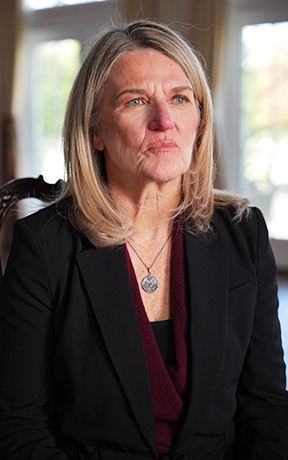
Leonie Huddy
The Psychology of Politics
A leading scholar in the study of political behavior and psychology at the individual and group levels.
Lesson Plan
- Lesson Length : 4 Lessons ㆍ 1 hours 07 miutes
- Language : 한국어, English
Exploring how personality, authoritarian tendencies, and social group dynamics influence individual
At a time when political behavior is more critical than ever, we have invited Leonie Huddy, a world-renowned scholar in the field of political psychology, to offer insights into the mechanisms behind our political actions and how to make rational political judgments.
In this lecture series, Leonie Huddy focuses on the factors that drive human political behavior. In the first lecture, Professor Huddy argues that due to the limitations of human cognitive systems, political behavior is inevitably influenced by "intuition" and "group dynamics." She highlights how group identity, when strongly tied to a specific political party, can escalate into hostility toward out-groups, ultimately leading to political polarization. Huddy further explains that in societies like the United States, where divisions based on race, ethnicity, religion, and region are pronounced, political polarization tends to be more severe.
In addition to group dynamics, Huddy identifies "personality traits" and "authoritarian tendencies" as critical factors influencing political behavior. She stresses the importance of understanding authoritarian tendencies, noting that individuals with such traits are not only prone to social conformity and violence against the vulnerable but are also highly sensitive to social threats, making them easily swayed by populist rhetoric. Many authoritarian leaders, she points out, exploit this vulnerability to their advantage.
To make rational political judgments, Professor Huddy emphasizes the need to invest time in thoroughly examining political issues and information, while also listening to opposing perspectives. She underscores the importance of understanding the context of political statements made by leaders, stating that only through such critical evaluation can one engage in sound political behavior.
Full Bio
Leonie Huddy
- American Political Psychologist
- Distinguished Professor of Political Science at Stony Brook University, New York
- Member of the Advisory Board for the American National Election Studies (ANES)
- Former President of the International Society of Political Psychology (ISPP)
- Former Co-Editor of the journal ⌜Political Psychology⌟
- ISPP Jean Knutson Award for Distinguished Service (2016)
- ISPP Nevitt Sanford Award for Distinguished Professional Contributions to Political Psychology (2014)
- American Political Science Association's Best Paper Award in the Women and Politics Section (1998)
Leonie Huddy is an Australian-born American political psychologist and currently serves as a Distinguished Professor of Political Science at Stony Brook University, New York. For nearly 40 years, she has focused on the topic of "political identity," studying ⌜Political Behavior in the United States through Gender, Racial, and Ethnic Group Relations⌟, and tracing the causes of societal change in America. In recognition of her contributions, she has received numerous accolades, including the American Political Science Association’s Best Paper Award in the Women and Politics Section (1998), the Nevitt Sanford Award for Distinguished Professional Contributions to Political Psychology (2014), and the Jean Knutson Award for Distinguished Service (2016) from the International Society of Political Psychology (ISPP).
As a former President of ISPP, Professor Huddy has also served as Co-Editor of the journal ⌜Political Psychology⌟, a member of the Advisory Board for the American National Election Studies (ANES), and a CBS Radio exit poll analyst. Through surveys, statistical analysis, and interviews, she has explored how political behavior changes over time and its underlying causes.
Currently, her research focuses on ⌜Partisan Identity and Political Polarization in the United States and Western Europe⌟, seeking strategies to mitigate the fragmentation of democracy. Her publications include <Going to War in Iraq: When Citizens and the Press Matter (2015)> and <The Role of National Identity: Media and Social Influences on Who We Are (2016)>. She also co-edited <The Oxford Handbook of Political Psychology>.
Other Series in
Politics





Service Change Notice
As of April 3, 2024, GREAT MINDS is now operated by Ubion CO LTD.
As a result, there is a change in membership, so We’re informing you.
Discontinuation of Membership Subscription Auto-Renewal
Memberships subscribed before April 3rd will not automatically renew and will expire. Therefore, if you wish to continue using the membership, please proceed with the subscription after the expiration of the subscription.Increase in Membership Subscription Prices
The prices of membership subscriptions have been increased due to rising labor and material costs. We sincerely appreciate your understanding regarding this price adjustment.| Before | After | |
|---|---|---|
| Monthly Membership | $ 4.99 | $ 9.99 |
| Annually Membership | $ 49.99 | $ 99.99 |
* The won price of the monthly/annual membership for Koreans has risen to 12,000 won and 120,000 won, respectively.
Thank you for your understanding
If you have any further inquiries, Contact Us
Service Update
Global lecture, G is becoming Grecture.
Expanded AI feature are powering the next evolution of the service.
Effective January 2, 2026
Domain: https://www.grecture.com
Automatic redirection will be provided.
Subscription:
Price changes from $9.99 to $15.
Auto-renewal will end. Please resubscribe to continue.
Thank you for being with us.